
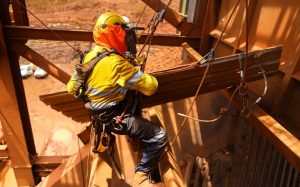
 When there is a risk of a fall of more than 2 metres there are regulatory requirements under the OHS regulations that must be adhered to for all work undertaken above this height.
The OHS Regulations require employers to apply what is known as the hierarchy of controls, which requires them to adopt the highest order control where reasonably practicable. This means to avoid doing the work at height in the first instance, and only when this is not reasonably using lower-level controls such as a fall-arrest systems that can provide adequate protection to the user.
There are number of different components to fall arrest systems that includes –
Full-body harnesses are designed to hold a suspended worker and distribute fall arrest forces across the shoulders, upper thighs, chest, and pelvis. Fall arrest harnesses feature a dorsal D-ring for attaching to the connector such as a lanyard and may have other D-rings for use in work positioning, travel restraint, retrieval or ladder climbing.
Lower-body harnesses comprise of a waist strap connected to a pair of leg hoops passing under the pelvis, designed to support the lower part of the body in a sitting position. The lower-body harness should be used in conjunction with a pole strap where a restrained fall is possible. Typical uses for lower-body harnesses include ladder and pole work, but should not be used if a fall of greater than 600 mm is possible.
Lanyards are used to connect a harness to an anchor point, horizontal life line or rail, or other forms of anchorage. A lanyard is designed to limit the force on the harness attachment point during a fall arrest.
There are three types of landyards, this includes, single-line, adjustable, and a twin-tail lanyard allowing the user to always be connected to an anchor point when transferring between anchor points.
Pole strap are used to support a worker on a pole and may be used with a full body or lower-body harness. A personal energy absorber should not be used with a pole strap.
Attachment hardware consists of Snaphooks, Karabiners and Tube nut connectors.
- Snaphooks consist of a hook-shaped body and gate, and can be opened to receive an attachment such as a ring on a harness or the eye of lanyard or sling.
- Karabiner consist of a connector with a spring loaded gate that opens to receive a mating connection and when released, automatically closes to retain the connection.
- Tub-nut connectors consist of an open loop with two threads that can be closed with a single tubular nut. They are considered amongst the safest as they require a succession of screwing actions to open them, and not prone to roll-out.